
Plans to change council boundaries in York, the number of councillors and wards have been unveiled.
The Local Government Boundary Commission for England (LGBCE) is proposing 48 councillors represent 22 wards on City of York Council in future.
That’s one more of each.
Commission chair Bev Smith said they were aware York was a unique place and they wanted to get the recommendations right.
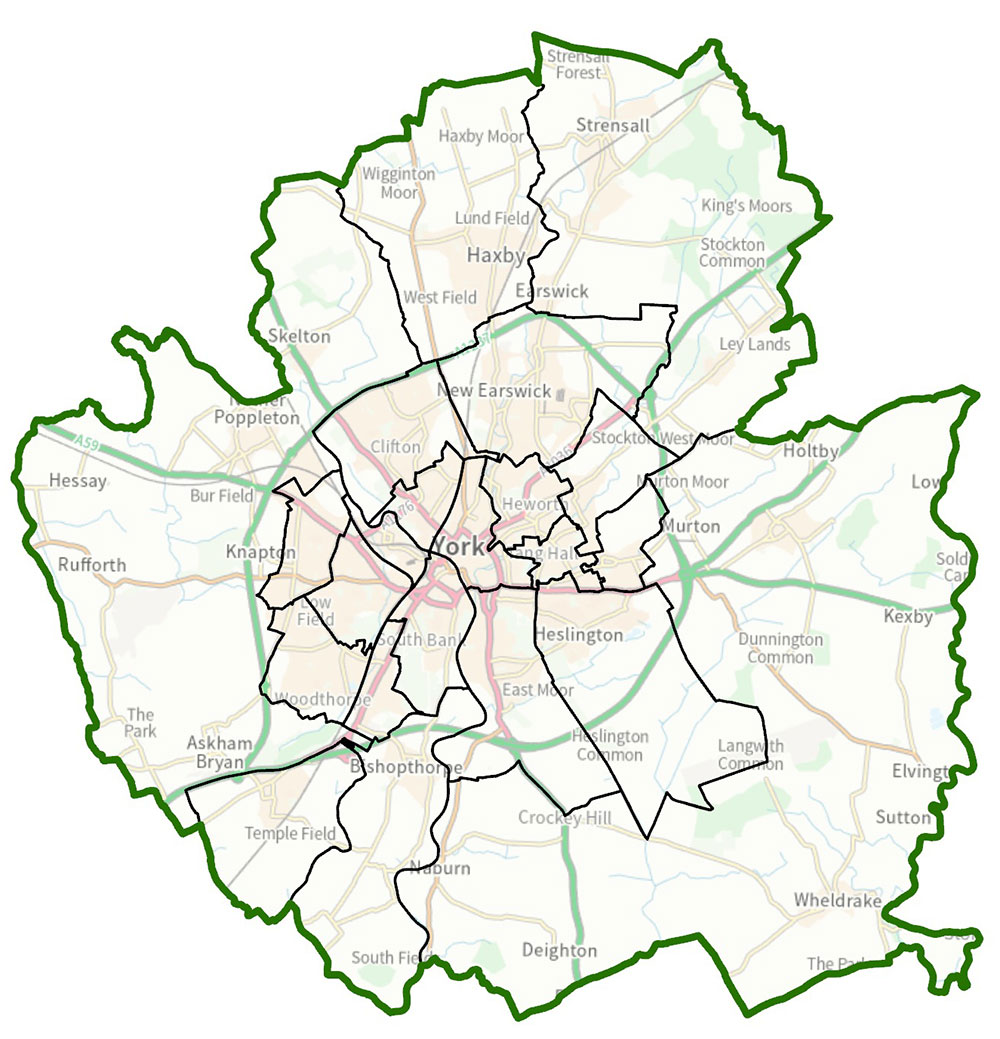
Among the proposed changes are Acomb split into an Acomb West ward and a Holgate & Acomb East ward.
Hull Road ward goes, with a new Heslington & University ward and a Derwent ward introduced.
A merged Fulford & Fishergate ward is brought in as is Tang Hall & Derwenthorpe.
A new one-member Leeman Road ward would be created in part to represent the upcoming York Central development where at least 2,000 new homes are set to be built.
Bishopthorpe and Copmanthorpe will continue to be covered by one ward each in light of signficant local evidence supporting keeping them seperate, the commission stated.
Changes to the parish councils of Murton, Osbaldwick, Rufforth with Knapton and Upper Poppleton to reflect changes to the council wards covering them.
The full list of the proposed ward boundaries
- Acomb West.
- Bishopthorpe.
- Clifton.
- Copmanthorpe.
- Derwent.
- Dringhouses.
- Fulford & Fishergate.
- Guildhall.
- Haxby & Wigginton.
- Heslington & University.
- Heworth.
- Heworth Without.
- Holgate & Acomb East.
- Huntingdon & New Earswick.
- Leeman Road.
- Micklegate.
- Osbaldwick.
- Rawcliffe & Clifton Without.
- Rural West York.
- Strensall.
- Tang Hall & Derwenthorpe.
- Westfield, Woodthorpe & Westhorpe.
Why the changes
The proposals have been drawn up as part of an ongoing Electoral Review launched last year.
Electoral Reviews of councils are carried out from time to time to reflect population and demographic changes in their areas, with the last one for York done in 2014.
The LGBCE is an independent body which oversees the reviews while taking input from the council’s political groups and the public.
Reviews aim to ensure each councillor represents roughly the same number of voters each.
The number of electors is set to go up from the 156,099 in last year to 170,031 by 2031.
Commission proposals include increasing the number of councillors to 48, up from 47 currently.
The council’s is currently made up of a 24-strong ruling Labour group, a Liberal Democrat opposition with 19 councillors, three Conservatives and one from Restore Britain.
A report on the proposals stated the commission felt 48 councillors offered the best balance for the council.
Labour had proposed increasing the number of councillors to 53 and the Liberal Democrats called for the total to be kept at 47 ahead of the latest proposals.
Conservative councillors said there should be cut to 41 and Restore’s Cllr Mark Warters, then an independent, said called for a reduction to 25.
Have your say
The council’s number of wards would increase by one from 21 to 22 if the proposals are adopted.
Most of the council’s boundaries will change, with three set to stay the same.
The draft recommendations propose ten three-councillor wards, six two-councillor wards and six one-councillor wards.
The LGBCE is set to unveil its final proposals in September following a public consultation which is currently ongoing.
Commission chair Ms Smith said they were keen to hear people’s views.
The chair said: “We have drawn up proposals for new wards and want to make sure they truly reflect local communities, but we need to hear from the people who know those communities best.”
People have until Monday, July 6 to have their say on the proposals.
Responses to the consultation can be submitted online by going here.